Automated production
Robotics, machine tools and intelligent systems that expand productive capacity and reduce dangerous or repetitive work.
A proposed independent research and coordination initiative to accelerate AI, robotics, automated manufacturing and abundant energy so humanity can provide a high standard of living with dramatically less required human labor.
North-star: investigate whether a 10–20 hour necessary-work week can become economically achievable while preserving human choice and broadly sharing the gains of automation.
A short introduction to the idea of using AI, robotics and automation to reduce necessary human labour—and ensuring people can share in the productive capacity these technologies create.
Video includes its title and subtitles. Use the player controls to play, pause, adjust volume, or view full screen.
What if humanity deliberately accelerated the technologies capable of performing economically necessary work, instead of allowing automation to emerge only as disconnected commercial projects?
Systems capable of planning, learning and controlling increasingly complex tasks.
General-purpose and specialized machines for physical work.
Manufacturing systems capable of building goods and, increasingly, other machines.
Abundant, reliable and affordable electricity to power the automated economy.
HLLP does not view artificial intelligence, robotics and automation as enemies of humanity. We view them as tools with the potential to liberate people from an enormous amount of necessary, repetitive, dangerous and physically demanding labour.
Technological progress will increasingly change which tasks require human effort. The central question is what we do with the productivity that progress creates—and whether its benefits can be shared broadly enough to increase human freedom.
If automation increases productivity while the benefits are concentrated among a small number of owners, it can deepen insecurity and inequality. If society develops effective ways to share those benefits, the same progress could reduce the amount of labour people must perform to live secure and fulfilling lives.
HLLP seeks to provide a positive social and economic framework for continued research and development in AI, robotics, automation and related technologies.
The goal is to direct growing productive capacity toward broader prosperity, economic security and more freedom over how people spend their time.
Automation should expand people's choices—not define their worth by their employment status or remove opportunities for meaningful, chosen work.
A future in which people are increasingly free to work because they choose to—rather than because they must work simply to survive—should not be treated as a threat to humanity. It is a possibility worth investigating and working toward.
HLLP's proposition: technological advancement should be welcomed and deliberately developed as a tool for human liberation, with research focused not only on what can be automated, but also on who owns the resulting productive capacity and how its benefits reach people.
HLLP explores how intelligent machines, worker ownership and automated infrastructure might work together to reduce the amount of necessary human labour—while keeping people, not technology, at the centre.
Robotics, machine tools and intelligent systems that expand productive capacity and reduce dangerous or repetitive work.
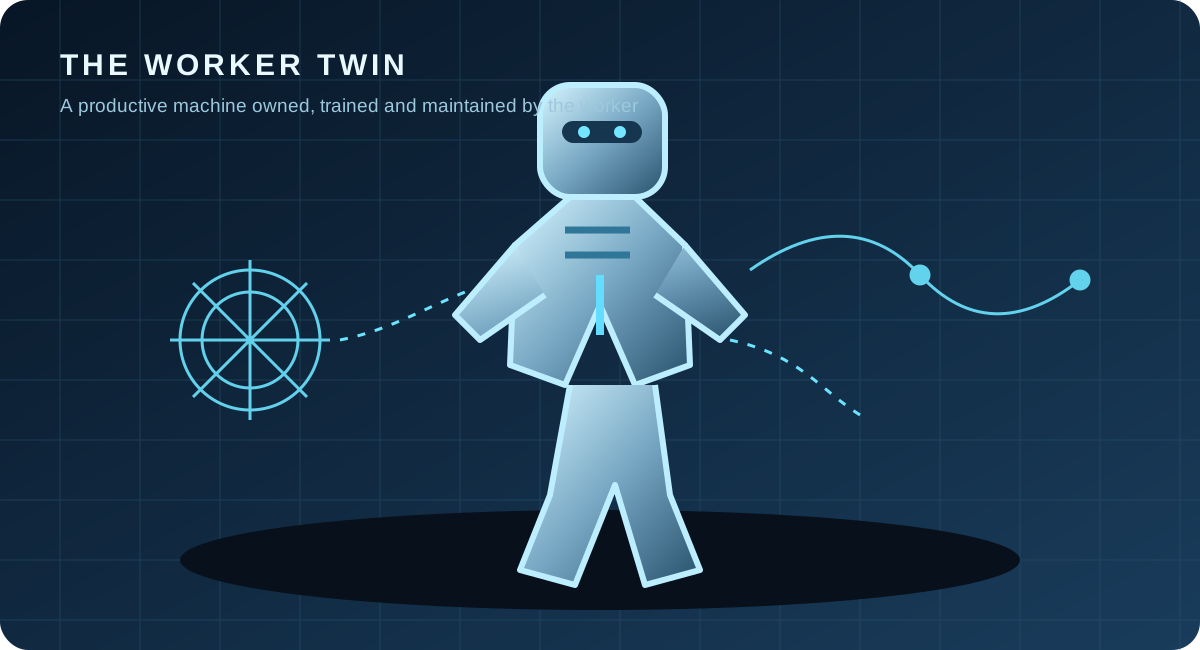
A proposed model in which a worker owns, trains and maintains the AI or robot that performs productive work.

AI, automation, energy and infrastructure coordinated toward broader prosperity and greater freedom over time.
Illustrative concept artwork created for HLLP; it is not a depiction of a completed system or a prediction of guaranteed outcomes.
AI and robotics may eventually perform a large share of the work currently performed by humans. HLLP asks an additional question: who owns the technology that performs that work?
HLLP is exploring a model in which a worker could own an AI and/or robotic system capable of performing some or all of the worker’s productive tasks. We call this a Worker Twin.
The worker owns the productive system rather than simply being replaced by a machine owned by the employer.
The worker could train, supervise, maintain and improve the system.
The machine performs productive work while the worker retains ownership of the asset.
HLLP’s overall roadmap has three major stages. The three milestone phases described below are subdivisions of Stage I—not replacements for the three-stage roadmap.
Build the multidisciplinary team, test the core assumptions, establish measurement and economic models, identify credible pilot opportunities, and produce a rigorous roadmap for 2028–2060. The initial US$1M milestone plan below is part of this broader Stage I program.
Develop and test selected automation demonstrations in areas such as construction, agriculture, manufacturing, logistics, household services and care. Validate what works, measure costs and productivity, and evaluate how ownership and benefits could be structured.
Expand validated approaches through industry, governments, philanthropy and infrastructure capital. The aim is to scale productive capacity while testing mechanisms that allow people broadly to benefit from automation.
The following three phases detail the initial US$1M milestone-based portion of Stage I. Funding is tied to deliverables, oversight and demonstrated progress.
Establish the organization and governance structure; recruit an initial group of recognized experts; establish independent advisory oversight; define the research methodology; conduct initial economic, technological and social analysis; identify university and laboratory partners; develop the detailed multi-year program; and establish financial controls and reporting.
Deliverable: A professionally developed HLLP research program, initial expert team and implementation roadmap.
Begin coordinated research across AI, robotics, economics, energy, automation, manufacturing, public policy, labor and social systems, infrastructure and resource allocation. Develop the baseline for measuring human labor-hours required to provide essential goods and services, and test the assumptions behind the Worker Twin concept.
Deliverable: Initial research findings, economic models, technology roadmap and policy framework.
Use findings from the first two phases to select and design suitable pilot projects or prototypes; expand research partnerships; test practical implementation models where feasible; publish results; and prepare proposals for the next, larger stage of work.
Deliverable: Documented research outcomes, pilot plans and a credible evidence base for Stage II.
Budget clarity: The three initial milestone phases total US$1M. They are not the entirety of the US$2M, 18-month Stage I budget; the remaining Stage I allocation would support the continuation and completion of the feasibility program, with detailed allocation and release tied to the approved work plan and oversight.
The core metric is human labor-hours required to provide a defined basket of essential goods and services.
Housing · food · energy · transportation · healthcare
Robot-hours · human-hours · output per unit of capital and energy
Free time · safety · access · income security · living standards
Technology alone does not determine distribution. HLLP would evaluate citizen investment funds, worker/public ownership, automated-production dividends, universal basic services, income support, open standards and competitive markets.
The goal is not to eliminate work. It is to eliminate the necessity of work for survival, while preserving the freedom to work for purpose, ambition, creativity, service or income.
18-month feasibility program. Assemble experts in AI, robotics, economics, energy, manufacturing, construction, agriculture, healthcare and governance. Produce a transparent model answering what it would take to move toward a 10–20 hour necessary-work economy.
This is intentionally small compared with the scale of the question. The first objective is to buy knowledge, coordination and evidence—not to promise a technological outcome in advance.
The project complements existing work. The Future of Life Institute supports work on beneficial futures and AI-related power concentration. Anthropic Economic Futures supports external research on AI's economic impacts, labor, productivity and sharing benefits.
HLLP would also seek relationships with robotics companies, AI laboratories, universities, energy and manufacturing organizations, governments and philanthropic funders.